Agency pricing after AI: stop comparing hours to hours
An hour of your team's time delivers more than it did two years ago, so a quote built on hours is now the wrong unit. Price the result, the risk you carry and the time to get there. Keep tracking hours internally, because they are your cost. Stop putting them on the invoice, because they are no longer your product.
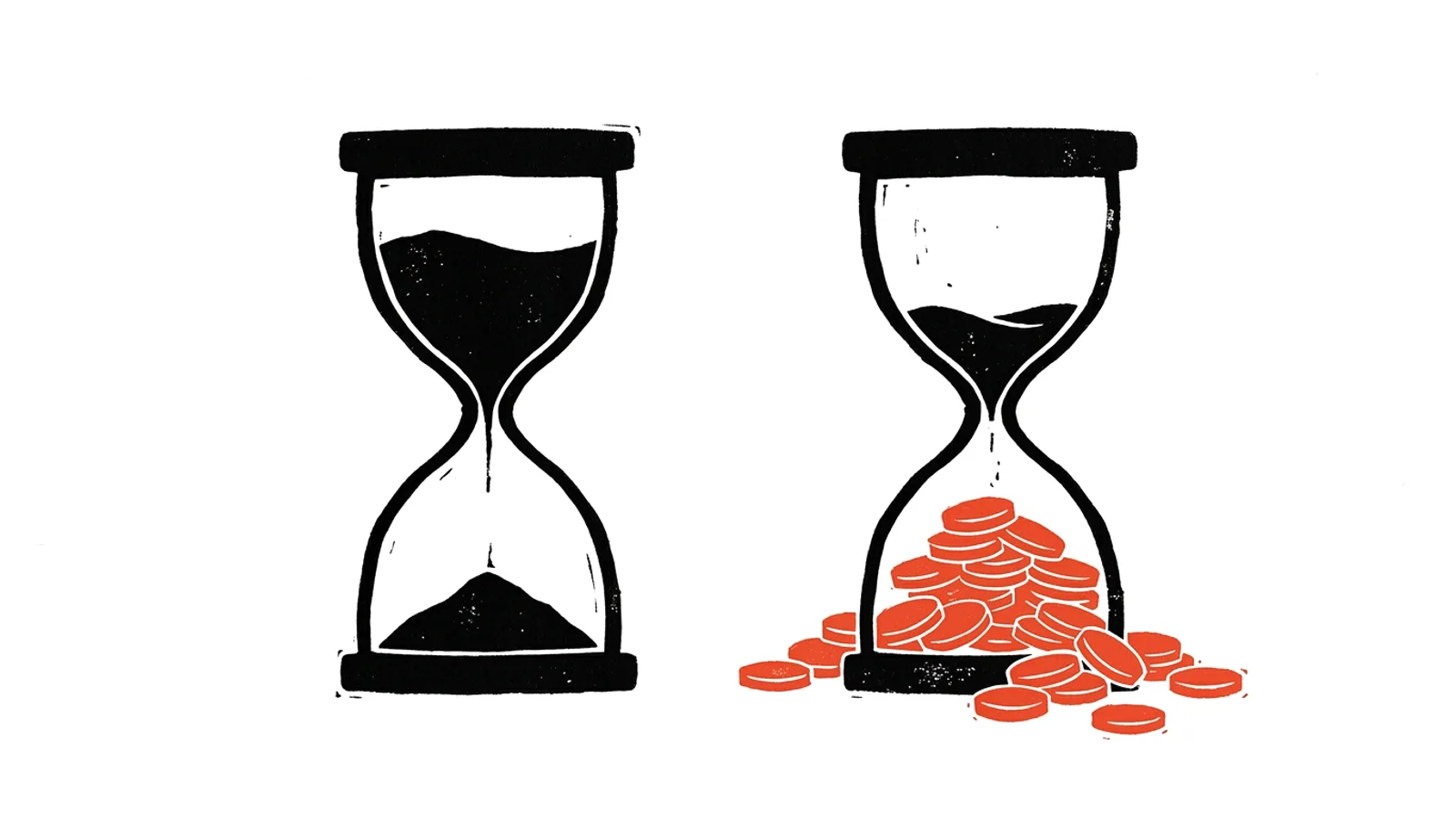
Two years ago my shop estimated a customer portal with invoicing at 400 hours. This year a comparable portal took 260. Same team, same stack, same quality. The difference was that the team now uses AI assistance properly: scaffolding, tests, boilerplate, the first draft of most things.
If I had billed both projects by the hour at $150, the second one would have earned $21,000 less than the first, for the same result. Getting better at the job would have cost me money. That is the whole problem with hourly billing in one sentence, and it is why comparing this year’s hours to last year’s hours, or your hours to a competitor’s, no longer tells anyone anything useful.
This page is about what to price instead, how to answer the client who says “surely this is faster now”, and how to move the clients you already have. The comparison between fixed price and time and materials on its own terms is in fixed price vs time and materials. The wider picture of what AI does to a services business is in is software engineering dead.
Why an hour stopped being a unit
An hour was always a proxy. The client did not want 400 hours. They wanted a portal. Hours were a reasonable stand-in for the portal because, for a given team, the hours it took to build one changed slowly. A client could compare two quotes in hours and learn something.
That proxy has broken, because the output of an hour now varies enormously depending on who is working and how.
| The same hour, spent by | Output |
|---|---|
| A junior typing code by hand | One unit |
| A senior with good tools, on a greenfield common stack | Three to five units on implementation tasks |
| A senior with good tools, inside an untested fifteen-year-old system | Barely more than one unit, because the constraint is understanding |
| Anyone, on discovery, client decisions and acceptance | About one unit, because AI does not make the client decide faster |
Two agencies quoting 300 and 180 hours for the same work may be quoting the same price for the same output, or may be quoting two different outputs. The number no longer separates them. What separates them is what they will deliver, by when, and who carries the risk if it goes wrong.
That is the unit to price.
What to price instead
Three things, in this order.
The result. What exists at the end that did not exist at the start, written down tightly enough that both sides know when it is done. That document is the scope of work or the statement of work. The price attaches to it.
The risk you carry. A fixed price moves overrun risk from the client to you. You are paid for carrying it, through contingency. The fixed price calculator turns your confidence in the estimate into the contingency you need. On a greenfield build the contingency is small because the AI gain is reliable. On a legacy integration it is large because the gain is not.
The date. Speed has a price. A team that can deliver in six weeks what used to take ten is selling something the client values, and the fastest way to realize the AI gain in revenue is often to sell the shorter timeline rather than a lower number.
Hours still matter. They are your cost, and the realized rate on each project is the only evidence of whether your prices are right. Track them daily. Just stop invoicing them.
The arithmetic, with the gain kept
Take the portal again.
| Last year, hourly | This year, hourly | This year, priced on the result | |
|---|---|---|---|
| Hours | 400 | 260 | 260 |
| Loaded cost at $85 per hour | $34,000 | $22,100 | $22,100 |
| Price | $60,000 | $39,000 | $60,000 |
| Gross margin | $26,000 (43%) | $16,900 (43%) | $37,900 (63%) |
| Effective rate | $150 | $150 | $231 |
Hourly, the margin percentage held and the margin in dollars fell by $9,100, because there were fewer hours to apply it to. Priced on the result, the shop kept the $21,000 it created by investing in tools and training.
Now the part owners skip. The 140 hours you no longer spend on the portal are not free money. You have to sell them to someone, in a market where every competitor also has 140 free hours. If you keep the price and the client count, your team delivers more projects in the same year and revenue rises. If you cut the price to match the hours, you need a third more clients to stand still. Priced on the result, the gain is yours to reinvest. Priced on hours, it was handed over before you noticed it existed.
When the client says “surely this is faster with AI”
They are partly right, and the honest answer has three parts. Say all three.
First, the implementation is a smaller share of the project than they think. On a well-run build, writing the code was about half the hours. Discovery, design, integration against their systems, testing on real data, deployment, security review and handover were the other half, and those move at the speed of the client’s decisions and the client’s systems. A big saving on half the project is a moderate saving on the whole.
Second, the saving is uneven and you can show them where it lands. Greenfield screens on a common stack: large. Their twelve-year-old ERP integration with no documentation: almost none. Put the two columns in the proposal. Clients respect a vendor who says “this part is faster and this part is not” far more than one who says “it all is” or “none of it is”.
Third, the price follows the value of the result and the risk you carry. A portal that saves them $300,000 a year is a good deal at $60,000 whether it took you 400 hours or 260. If they want the AI gain in the price, offer it as more scope for the same money, or the same scope sooner. Both are worth more to most clients than a discount, and both keep your margin intact.
If they want the lower price and nothing else, reduce the scope to match. Never lower the price for the same scope. The moment you do, you have told the client that your prices were padded, and every future quote starts from there.
If you have to stay hourly
Some work does not have a definable result. A legacy investigation where nobody knows what is in there. An augmentation seat embedded in the client’s team. Early-stage products where the scope changes weekly. Hourly is the honest model for these, and the fix is the rate.
Reprice the hour to what it now produces. If a senior with good tools delivers in one hour what took two, the rate on that hour should move toward what two used to cost. Not all the way, because the client will go elsewhere and because some of the gain is theirs for buying the modern team, but a long way. Say so plainly: “Our rate reflects output per hour, which is higher than it was.”
Three rules make hourly survivable:
- Rate tiers by output. A senior with tools is a different product from a junior without them. Price them differently and let the client choose.
- A weekly budget report against a written estimate. Hourly without a reported estimate is how a client stops paying.
- No not-to-exceed cap. A cap gives the client fixed-price certainty and gives you hourly upside only when you finish early. That is the worst of both. If they want a cap, sell them a fixed price with proper contingency.
Moving the clients you already have
Do not reprice a client mid-project. Do it at the next natural break: a new phase, a new project, a renewal.
Present the next piece of work as a scoped, priced package with a date, in the format of the statement of work template. Put the price next to what the same scope would have cost on last year’s hourly estimate, so the number looks familiar and the certainty looks like the new part. For retainer clients, the move is from hours per month to a defined service level, which is covered in retainer pricing.
Expect one in five to push back. Those are usually the clients who liked hourly because it let them add work without a conversation. The scope document closes that door, which is the point. Scope creep is the other place the AI gain disappears, and it is covered in scope creep.
The models, ranked for a team that is getting faster
| Model | What happens to the AI gain | Verdict |
|---|---|---|
| Hourly at the old rate | Goes entirely to the client | Stop |
| Hourly at a repriced rate | Shared, by negotiation | Acceptable for undefined work |
| Fixed price on a tight scope | Stays with you, if scope holds | Default for defined work |
| Retainer on a service level | Stays with you, as capacity | Good for ongoing work |
| Value-based | Stays with you, plus a share of the upside | Best, where the value is visible |
| Productized | Stays with you, compounding | Best, where the work repeats |
The last two are harder to sell and are covered in value-based pricing and productized services. The full comparison is in agency pricing models and the Bill hub.
The short version: your team’s hour is worth more than it was. Price what the hour produces, or someone else will.
Common questions
- Should an agency still bill by the hour at all?
- For open-ended work where nobody can define the outcome, such as a messy legacy investigation or a staff augmentation seat, yes, at a rate that reflects what an hour now produces. For anything with a definable result, price the result. Keep timesheets either way, because hours are still your cost.
- What do I say when a client asks for a discount because of AI?
- Agree that some parts are faster, show which parts of the project those are, and offer the saving as more scope or an earlier date rather than a lower price. If they only want a lower price, offer a reduced scope. Never lower the price for the same scope.
- How do I move an existing hourly client to a fixed price?
- At the next natural break, a new project or a renewal, present the next piece of work as a scoped, priced package with a date. Show the price alongside what the same work would have cost hourly last year, so the number looks familiar. Most clients prefer certainty once it is offered plainly.
- Does fixed pricing mean I absorb the risk that AI does not speed up the work?
- Yes, which is why the price includes contingency and the scope has clear boundaries. The risk is real on legacy and integration-heavy work, where AI helps least. On greenfield work on a common stack, the risk is low and the gain is large. Price each project on its own uncertainty rather than an average.